When engines are tested under load in an engine test bench, large amounts of heat and exhaust gases are produced. These emissions must be extracted safely and reliably to ensure accurate measurements and a safe working environment.
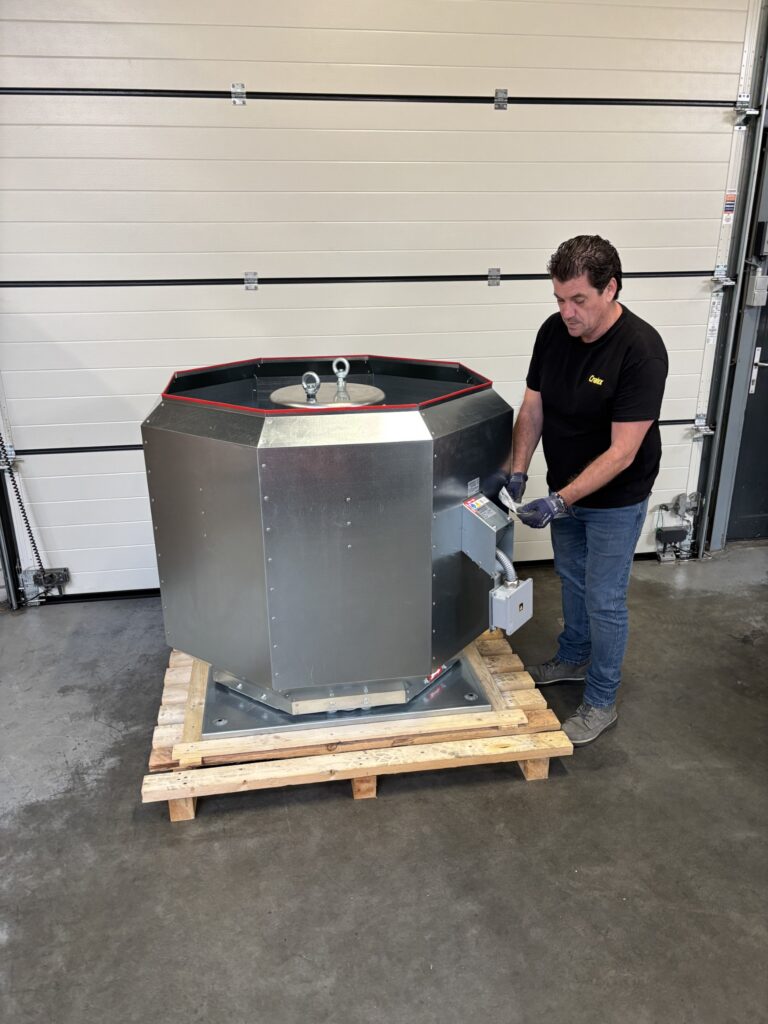
For a recent project, we supplied a centrifugal roof fan for the ventilation of an engine test cabin.
What is an engine test bench?
An engine test bench (also called an engine test cell or dynamometer test room) is a controlled environment where engines operate under different load conditions. During testing, performance parameters such as power output, torque, temperature development and emissions are measured.
Because engines continuously produce exhaust gases during testing, a properly designed exhaust extraction and ventilation system is essential.
Combination of source extraction and general room ventilation
Above the test setup, a large extraction hood of approximately 10 m² is installed. This hood extracts both:
- Exhaust gases directly from the engine
- Ambient air from the test room
The system therefore combines:
- Local exhaust ventilation (LEV)
- General room ventilation
- Temperature control within the test cell
This ensures safe working conditions and stable measurement results.
System resistance and pressure loss considerations
In this installation, the airflow travels approximately 12 to 15 meters through ductwork, multiple silencers and a chimney before reaching the fan.
In engine test bench ventilation systems, airflow volume alone is not sufficient for proper fan selection. Key design factors include:
- Pressure loss in ducts and fittings
- Resistance caused by silencers
- Exhaust gas temperature
- Total system resistance
Accurate calculation of these parameters ensures reliable and efficient system performance.
Selected solution: centrifugal roof fan up to 200°C
For this project, a centrifugal roof fan suitable for exhaust gas extraction up to approximately 200°C was selected.
The fan is equipped with a vertical discharge cap, allowing controlled and safe upward discharge of the extracted air.
The result is a robust ventilation solution designed to handle both exhaust gases and room air extraction in a demanding engine testing environment.