
Fan installation and airflow: common challenges and practical solutions
When installing a ventilation system, airflow and duct design play a crucial role in the performance of a fan.
In theory, the process seems straightforward: select a fan, connect the ducts and start the system. In practice, however, installations rarely take place under ideal conditions. The building structure and available installation space are often already defined, which means the ventilation system must fit within certain constraints.
As a result, duct layouts are not always optimal. Sharp bends close to the fan, obstacles near the inlet or insufficient straight duct lengths are common in real installations.
When a ventilation system produces more noise, vibration or delivers less airflow than expected, the fan is often blamed first. In many cases, however, the correct fan has been selected, but the airflow around the fan is disturbed.
Disturbed airflow can lead to:
- a fan delivering less airflow than calculated
- higher noise levels
- additional pressure losses in the system
- increased energy consumption
- accelerated wear of bearings and motors
In this article we explain where these challenges come from, how to recognise them and how to solve them.
Why airflow and duct design are important
Fans are selected based on a fan curve, where airflow, pressure and efficiency are determined under ideal conditions.
In real installations those conditions are rarely perfect. When air cannot enter or leave the fan smoothly, turbulence occurs.
Turbulent airflow can cause:
- additional pressure losses in the duct system
- reduced airflow from the fan
- higher noise levels
- increased motor power consumption
For this reason, airflow and duct design play a key role in the overall performance of a ventilation system.
Difference between axial and centrifugal fans
Axial and centrifugal fans distribute air differently at the outlet.
Axial fans move air in a relatively straight airflow and perform best when air can flow smoothly through the duct system with minimal disturbances.
Centrifugal fans have a more asymmetrical airflow pattern at the outlet. Because of this, the position of a duct bend or connection can have a greater influence on fan performance.

By taking this into account during the design of the duct system, many installation problems can be prevented.
Common problems in fan installations
Problems at the fan inlet
For a fan to operate properly, a stable and uniform airflow is essential. When air cannot enter freely, an irregular airflow develops inside the fan.
Common causes include:
- a wall or obstacle directly in front of the fan
- a bend immediately before the fan
- insufficient straight duct length
- turbulence in the duct
This can lead to:
- a fan that does not deliver the desired airflow
- increased fan noise
- vibrations in the fan or ductwork
- higher energy consumption
In the image below, two scenarios of airflow into an axial fan are shown:
- Not recommended: obstacles or bends directly in front of the fan, which disturb the airflow
- Recommended: even in limited space, the airflow can be stabilized using an enclosure or guide, ensuring uniform entry into the fan
This clearly illustrates that proper airflow management—even in tight spaces—can significantly improve fan performance.

Problems at the fan outlet
Problems can also occur on the discharge side of the fan.
A typical example is a sharp 90-degree bend directly after the fan.
In this situation, the airflow does not have enough space to stabilise before changing direction.
This can cause:
- turbulence in the airflow
- additional pressure losses
- reduced fan performance
Problems caused by limited installation space (system effect)
In many projects the available installation space is limited. This often forces fans and ductwork into compact configurations.
As a result, both the inlet and outlet conditions of the fan may be less than ideal.
Typical examples include:
- a fan installed too close to a wall
- a duct bend directly before or after the fan
- insufficient straight duct length
This can cause air recirculation or uneven airflow entering the fan.
In ventilation engineering this phenomenon is known as system effect. In these situations the fan does not deliver the performance shown in the fan curve because airflow conditions around the fan are disturbed.
How to recognise system effect
System effect can show itself in several ways:
- the fan does not reach the calculated airflow
- the fan produces more noise than expected
- the motor consumes more electrical power
- vibrations occur in the fan or duct system
When these symptoms occur, it is important to look not only at the fan but also at the duct configuration around it.
Solutions for fan installation problems
Optimising duct bends
If a bend close to the fan cannot be avoided, the following measures may help:
- use a larger bend radius
- apply turning vanes (airturns)
- create additional straight duct length between fan and bend
- install a plenum chamber or air distribution box

Correct installation of flexible connections
Flexible connections are used to prevent vibration transfer between the fan and the duct system.
However, they must be installed correctly.
A flexible connection should:
- be able to move freely
- not be under tension
- not be used to compensate for major alignment errors
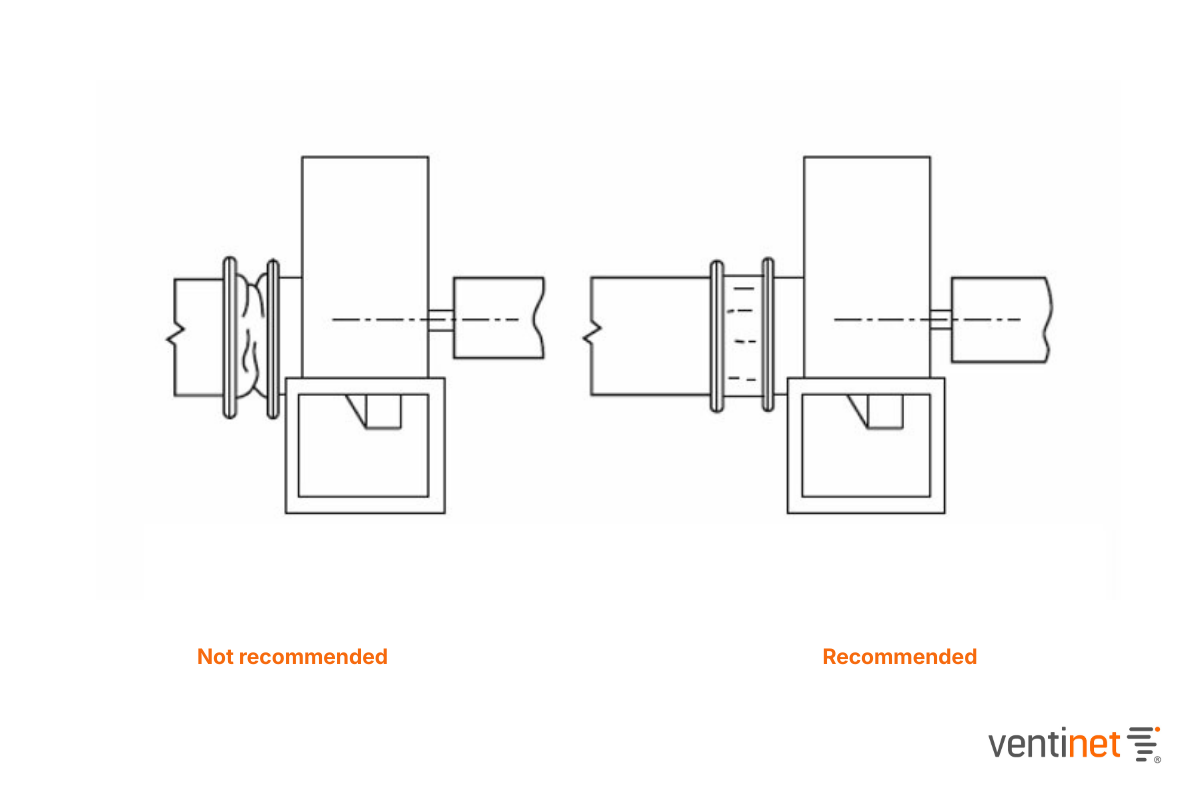
Correct discharge position for centrifugal fans
With centrifugal fans, the discharge direction can influence performance when a duct bend is placed directly after the fan.
Ideally, the first bend follows the natural airflow direction leaving the fan.

For more information, read our article about discharge positions of centrifugal fans.
5 quick design rules for fan installations
When designing or installing a ventilation system, these guidelines can help prevent performance problems:
- Provide sufficient straight duct length at the fan inlet (minimum 2–3 duct diameters).
- Avoid sharp 90° bends directly before or after a fan.
- Use turning vanes or larger bend radii when bends are unavoidable.
- Ensure sufficient free space around the fan for stable airflow.
- Align the discharge direction of centrifugal fans with the first duct bend.
These simple design rules can prevent many performance issues in ventilation systems.
Conclusion
When a fan installation produces more noise, delivers less airflow or consumes more energy than expected, the problem is not always the fan itself.
In many cases the cause is system effect: disturbances in the airflow around the fan caused by an unfavourable duct configuration.
By considering airflow patterns, duct lengths and duct bends during design and installation, engineers and installers can:
- reduce noise and vibration
- lower energy consumption
- limit component wear
- improve the overall performance of the ventilation system

Need advice? Let’s talk.
We’re available Monday to Friday from 8:30 to 17:00.


